Fire leaves a strange silence behind. Smoke clears, fire trucks leave, and then you’re standing in front of a fire damaged house in North Carolina wondering what on earth you’re supposed to do next. Homeowners in that position have rarely sold a house in their lives, let alone a damaged one. The decisions you make in the weeks right after a fire will shape every option available to you, so getting oriented fast matters more than it might appear.
This guide walks you through all of it: what the law requires, what your real options actually are, and how to move forward without hemorrhaging money on repairs you may never recoup.
What Should You Do Right After a House Fire in North Carolina?
Your mortgage lender is almost certainly named as a co-payee on your homeowner’s insurance payout check. Most homeowners don’t find this out until they’re holding the check, and it stops the entire process cold. Your lender has a legal interest in the property and, therefore, in the insurance proceeds, so they get a say in how those funds are used, whether for repairs or to pay down the loan balance. Call your lender before you do anything else.
Beyond that first call, your immediate priorities should be these: Contact your insurance company and file your claim. Your insurance adjuster will schedule an inspection; don’t make permanent repairs or hire contractors before that visit, because undocumented pre-inspection work can complicate or reduce your payout.
Document everything you can photograph. Every room, every angle, before any debris is removed. Your insurance claim, your disclosure obligations under North Carolina law, and any future sale all depend on having a clear record of the property’s condition at the time of the fire (smoke damage spreads further than it looks). Get a structural safety inspection from a licensed contractor before re-entering the home. Properties in older neighborhoods of Durham or the historic sections of Salisbury can have structural vulnerabilities that aren’t obvious from the outside.
Secure the property. Board windows, lock or barricade entry points, and post it clearly to limit liability. If someone wanders into an unsecured fire-damaged structure and gets hurt, you could be on the hook. If you’re considering selling instead of repairing, North Carolina cash buyers can be one option to explore.
What Is a Fire-damaged House?
Misclassifying your own property’s damage level is one of the most expensive mistakes a seller can make. Overestimate it, and you’ll price yourself into a corner; underestimate it, and you’ll spend money on partial repairs that don’t solve the problem a buyer’s lender will flag anyway.
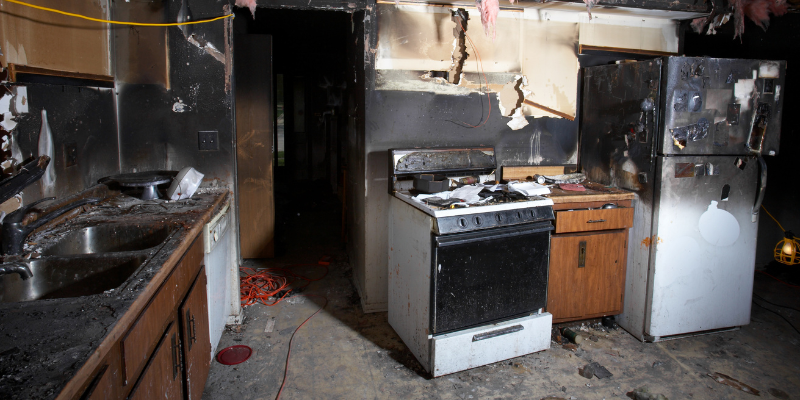
A fire-damaged house falls somewhere on a wide spectrum. On one end, you have cosmetic smoke and soot damage: scorched paint, discolored ceilings, and that persistent smell that gets into drywall. On the other end, you have a total-loss or near-total-loss situation where structural elements, load-bearing walls, the roof, or the foundation are compromised. Properties typically land somewhere in the middle, with a combination of visible fire damage, hidden smoke infiltration in wall cavities, and secondary damage from water used to fight the fire.
Mold is where a lot of sellers run into unexpected problems. Water from fire suppression soaks into subfloors and wall cavities within hours, and mold can begin to establish within 24 to 48 hours if the structure isn’t dried quickly. A property in Greensboro or Sanford that sits closed up for three weeks after a kitchen fire can have a mold problem layered on top of the original fire damage, and that changes the math on repairs entirely (remediation quotes tend to double when mold’s involved).
Insurance companies use the term “total loss” when the cost to restore a property exceeds its pre-fire market value, though each homeowner’s insurance policy has its own threshold language. Knowing which category you’re in, cosmetic, partial, or total-loss, determines which buyers can even legally purchase your home and what disclosure documentation you’ll need to prepare.
Can You Sell a Fire-damaged House in North Carolina?

So, given all of that, yes, selling is absolutely on the table. You need to identify who you can realistically sell to. The NC Residential Property Disclosure Statement asks you about known damage, and fire damage certainly counts. But disclosure is not a barrier to sale. It is just transparency. The disclosure form is governed by North Carolina General Statutes § 47E-4 and § 47E-5, and sellers must deliver it no later than the time a buyer makes an offer. The form does let an owner answer “No Representation” instead of describing the condition, but hiding known fire or smoke damage can still expose you to a claim for concealing a material defect, so answering the Residential Property Disclosure Statement honestly is the safer route.
Conventional financing is where the process falls apart for most buyers. Most traditional buyers cannot purchase a fire-damaged property because their lender will not approve the loan. Conventional mortgages, FHA loans, and VA loans all require the home to meet minimum habitability standards. A fire-damaged house will fail the appraisal before the buyer even gets to the inspection.
That’s not a dealbreaker. It just means your buyer pool narrows to cash buyers, real estate investors, and renovation-focused buyers who aren’t relying on traditional lending. Cash home buyers work specifically in this space, purchasing fire-damaged properties across North Carolina without requiring repairs or a clean inspection report first. For sellers who don’t want to manage contractors, wait out a six-month restoration timeline, or gamble on what the MLS will produce, that’s a real and practical path forward.
If you’d rather avoid repairs and the uncertainty of a traditional listing, Bright Home Offer can make a cash offer for your fire-damaged property as-is. You won’t need to wait for traditional financing, complete costly repairs, or worry about whether the property will pass a lender’s inspection.
What Are Your Options for Selling a Fire-damaged House in North Carolina?
Some sellers push back on this: “Won’t I get a much lower price from a cash buyer?” Sometimes, but not always, and the comparison isn’t apples-to-apples. Your real options break into three categories. The first is to repair and list on the MLS, meaning a full restoration and then a listing through a real estate agent. This approach maximizes potential sale price but means fronting significant capital, managing contractors, carrying the property for months, and accepting the risk that your completed renovation doesn’t appraise at what you spent. It’s the right path for sellers who have the capital, the time, and the stomach for it.
The second is to sell as-is through a realtor, listing the home in its damaged condition on the MLS. This avoids repair costs but produces longer days on market, multiple failed sales due to financing, and eventual price reductions. The buyers who can close on a damaged property through traditional channels are genuinely rare, and waiting months just to land back where you started is the likely outcome.
The third is to sell directly to a cash buyer or investor. The offer reflects the property’s condition, but the speed and certainty have real value, especially for sellers carrying two mortgages or racing to settle an estate.
Which option fits depends on your equity position, your timeline, and how much of the restoration your insurance payout covers. A North Carolina real estate attorney can help you structure whichever path you choose.
Reasons to Sell Your Fire-damaged House in North Carolina Without Repairs
Repairing a fire-damaged house to sell it on the open market rarely pencils out the way the math suggests it will. Restoration costs on a mid-level fire in a typical North Carolina home routinely run from $40,000 to well over $100,000 once you factor in structural repairs, smoke remediation, mold treatment, and code-compliance upgrades required when you pull permits. North Carolina’s building code requires that certain systems be brought up to current standards when work is permitted, which means a repair project can trigger upgrades the pre-fire house never needed (electrical panels are a common one).
Then there’s the time. A full restoration takes months. In its July 2026 housing report, NC REALTORS put the state in a balanced market, with inventory up to 6.03 months of supply, total active listings up 6.2% year over year, and a median sale price of $375,000. More inventory means more competition for a restored property. By the time you finish repairs, the market you’re selling into will be different from the one you planned for.
Carrying costs accumulate fast. Property taxes, insurance (which can become difficult or expensive to maintain on a damaged structure), utility minimums, and mortgage payments don’t pause for a renovation. Selling the property as-is, without repairs, eliminates every one of those ongoing costs from the moment you close.
Does the property need to be in perfect condition to command a fair price? No. A serious buyer prices in the repairs and still makes an offer based on what the home is worth in its current state. The offer won’t equal a fully renovated property’s value, but the difference is often smaller than it appears once you subtract the cost of repairs, holding time, and transaction costs from the renovation scenario. If you’re considering an investor house buyer in Fayetteville and other North Carolina cities, an investor may be able to evaluate the property based on its current condition and make an as-is offer without requiring you to complete the repairs first.
How Do Cash Buyers Work for Fire-damaged Homes in North Carolina?

Here’s what I’d actually say to a seller sitting across the kitchen table: the process is simpler than you’re probably imagining, and the offer you get is the offer you close on, no last-minute renegotiations after an inspection surfaces something the buyer “didn’t know about.”
Cash buyers who specialize in fire-damaged properties evaluate your home based on two things: what it would be worth fully repaired (the after-repair value, using comparable sales in your area), and what it will cost to get it there. The repair estimate comes from their own experience with contractors and restoration crews, not from your renovation budget. The difference between those two numbers, minus their margin, is what they offer you.
You receive a written, no-obligation cash offer within 24 to 48 hours. You choose your closing date, as fast as 7 to 14 days or on a timeline that works for you. The closing happens with a licensed NC title company, with liens, seller disclosures, and paperwork handled professionally. There are no agent commissions deducted, no repair demands, and no last-minute renegotiations after an inspection.
When selling to a cash buyer as-is, disclosed damage rarely affects the transaction, because cash buyers account for it in their offer. That’s a meaningful distinction from a traditional listing, where disclosed damage creates anxiety, renegotiation, and sale failures.
What Do North Carolina Home Buyers Look for in Fire-damaged Properties?
What does a real estate investor evaluate when walking through your fire-damaged house? Foundation, load-bearing walls, and roof structure determine a fire-damaged house’s value. A buyer can absorb cosmetic damage without blinking; smoke-stained walls, ruined flooring, and a scorched kitchen are all line items on a renovation budget. Foundation damage, compromised load-bearing walls, or a roof structure weakened by heat and water changes the math completely. Those repairs are expensive, unpredictable, and sometimes not worth the investment depending on the neighborhood.
A damaged property needs a strong location just as much as a pristine one does. A fire-damaged home in a strong submarket like South End Charlotte, North Raleigh, or downtown Winston-Salem carries a different floor value than an identical structure in a slower market. The land underneath the house has value independent of what’s on it. Investors in North Carolina’s growing metro areas sometimes purchase total-loss properties purely for the lot, particularly in neighborhoods where teardown-and-rebuild makes economic sense.
Documentation helps. Having your insurance adjuster’s report, any contractor estimates you’ve already received, and a clear paper trail of what happened makes the evaluation faster and the offer more precise. A buyer who has to estimate the unknown is going to build in a wider cushion. Give them clarity, and you’ll generally see a better number.
If you’re ready to sell your fire-damaged property, contact us for a no-obligation cash offer. We’ll evaluate the property based on its current condition and provide a straightforward offer without requiring you to make repairs first.
How Fast Can You Sell a Fire-damaged House in North Carolina?
With total sales down 13.2% year over year in that same July 2026 report, the broader NC market is seeing longer days on market, and sellers are being guided to prepare for extended timelines. For a fire-damaged property on the MLS, that already-slower pace compounds. Fire-damaged homes on traditional listings commonly sit for four to six months before either selling at a steep discount or being pulled from the market altogether.
Cash buyer timelines are a different category. Most serious cash buyers in North Carolina can close in two to three weeks if your title is clear. If there are complications, like an open insurance claim, a co-owner who needs to be located, or liens against the property, closing may take longer, but those issues exist regardless of how you sell.
Early last year, I purchased a fire-damaged duplex from a young couple in Raeford who had inherited it from a family member and never wanted to be landlords in the first place. They’d been collecting below-market rent, then a kitchen fire left one unit uninhabitable. The garage was full of the prior owner’s tools and equipment that the family hadn’t sorted through yet. We closed in 18 days, and they walked away with cash without ever hiring a contractor or scheduling a showing.
That kind of speed has real financial value. Every month a damaged property sits is another round of property taxes, insurance costs if you can maintain coverage, and mortgage payments if you still carry a loan. Certainty on a close date lets you plan around it.
How to Sell a Fire-damaged House As-is in North Carolina
Selling as-is in North Carolina starts with your disclosure obligations. Complete and honest documentation of all known damage on the NC Residential Property Disclosure Statement protects you from post-closing liability. NC courts hold a seller liable when the seller had actual knowledge of the defect and kept it quiet. Full disclosure is your legal protection, not a liability, and in my experience it also keeps sales from falling apart at the last minute.
In North Carolina, once the seller has delivered possession at closing, the seller has no ongoing duty to return and fix small issues. The main exceptions are when the contract specifies the property must be in substantially the same condition at closing, when a disclosure issue or misrepresentation is involved, or when the parties later sign a written settlement that creates new obligations.
Gather your insurance documentation, the adjuster’s report, and any contractor estimates you have. Even if you don’t intend to make repairs, buyers want to see what the professionals said. Price the property honestly for its current condition, work with a buyer who can close without financing contingencies, and get to the closing table. If you’re looking for a cash-for-houses company in Hope Mills and other North Carolina cities, contacting a local cash buyer can give you another option for selling the property as-is.
Frequently Asked Questions
How Do You Sell a Burned House?
Selling a burned house starts with contacting your insurance company and getting an adjuster’s report that documents the damage. From there, you have two realistic paths: invest in repairs and list on the MLS, or disclose the damage on the NC Residential Property Disclosure Statement and sell as-is to a cash buyer. Most sellers with significant fire damage find the cash buyer route faster and more financially predictable, since financed buyers can’t typically close on a property that fails a lender appraisal.
How Long Are You Liable for Repairs After Selling a House in North Carolina?
Your liability after closing largely depends on what you disclosed and what the contract required. If the contract is silent about post-closing repairs, the seller’s obligations usually end when title transfers and possession is delivered at closing. The exception is intentional concealment: if a buyer discovers after closing that you knew about a material defect and failed to disclose it, they have grounds to pursue civil action, which can include reimbursement for repair costs, attorney fees, and in some cases, attempts to reverse the sale. Accurate, complete disclosure on the front end is the cleanest protection you have.
Does a House Lose Value After a Fire?
It depends on the damage level. Cosmetic smoke damage reduces value less than structural fire damage. Unrepaired fire damage can reduce a property’s value by a wide margin depending on the extent of structural compromise and the strength of the local market. Properties in high-demand corridors like the Research Triangle or Charlotte suburbs tend to hold floor value better because the land itself retains worth even when the structure is severely damaged. Fully restored properties in strong submarkets often rebound to or near pre-fire values, but the costs to get there are the variable most sellers underestimate.
If you’re sitting with a fire-damaged property in North Carolina and you’re not sure what to do next, Bright Home Offer is here to talk through it with you. No pressure, no obligation. Whether you want to explore a cash offer, understand your disclosure requirements, or just figure out what the property is actually worth right now, reach out to us at (984) 983-4158 and we’ll give you a straight answer.
Helpful North Carolina Blog Articles
- Selling A House During Divorce In North Carolina
- Do Sellers Pay Closing Costs In North Carolina
- Selling A Hoarder House In North Carolina
- Selling A Probate House In North Carolina
- How To Sell Your House In Foreclosure In North Carolina
- Can You Sell A House As Is Without An Inspection In North Carolina
- How to Sell a House with Foundation Issues in North Carolina
- How to Sell a Fire Damaged House in North Carolina
- How to Sell a House Without a Realtor in North Carolina
- How to Sell a Condemned House in North Carolina
- Sell House With Water Damage in North Carolina
- Selling Tenant Occupied Property in North Carolina
- Do i Need a Lawyer to Add a Name to a Deed
- Can you Sell a House with a Mortgage in North Carolina
- Documents Required for Selling Inherited Property in North Carolina
- Can I Sell my House and Still Live in it